







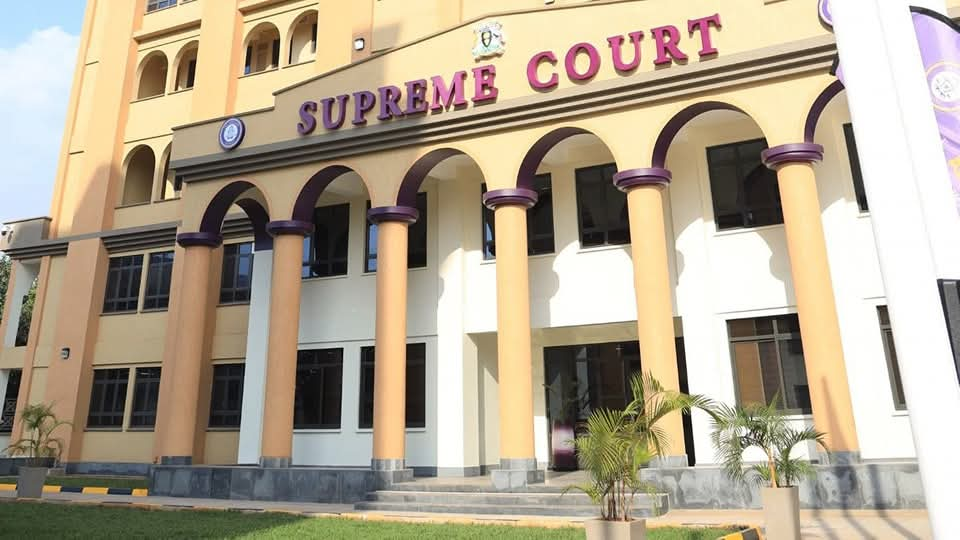
Kampala– The Supreme Court on Monday, dismissed an application seeking to halt all elections scheduled for 15 January 2026, including the presidential election, ruling that it lacks the constitutional mandate to intervene in pre-election disputes.

The application, filed under Civil Application Nos. 23 and 24 of 2025, arose from earlier matters including Presidential Election Petition No. 1 of 2016 and Civil Application No. 005 of 2019. It was filed by Mukisa Patrick against the Attorney General, the Electoral Commission, and H.E. Yoweri Kaguta Museveni, President of Uganda.
Mukisa asked the Court to make a series of declarations based on previous Supreme Court decisions arising from the 2016 presidential election and to restrain the Electoral Commission from proceeding with the forthcoming polls. In effect, he sought pre-emptive judicial intervention to address what he described as constitutional and electoral concerns, despite not being a presidential candidate or a person legally authorised to file a presidential election petition under the Constitution.
The matter was heard by a coram of seven Justices: Lady Justice Prof. Lillian Tibatemwa-Ekirikubinza, Justice Mike Chibita, Justice Stephen Musota, Justice Christopher Madrama Izama, Lady Justice Catherine Bamugemereire, Lady Justice Monica Mugenyi, and Justice Muzamiru Mutangula Kibeedi. The panel considered both oral and written submissions, as well as the pleadings on record.
In its ruling, the Court found the application incompetent on several grounds. It held that the applicant lacked locus standi to invoke the original jurisdiction of the Supreme Court. The Justices underscored that Article 104 of the Constitution applies strictly to post-election presidential petitions filed by aggrieved candidates.
The Court further observed that the dispute was pre-election in nature, a category over which the Supreme Court has no original jurisdiction. Under Article 132 of the Constitution, the Court’s mandate is primarily appellate. Pre-election complaints, the Court clarified, fall within the jurisdiction of the Electoral Commission, with appeals to the High Court.
Additionally, the Justices ruled that the Supreme Court has no power to issue an injunction restraining the holding of presidential elections, as such an order would contradict the mandatory constitutional duty imposed on the Electoral Commission under Article 61(2) to conduct elections.
The Court also found that the third respondent, the sitting President, had been improperly sued, citing constitutional provisions on presidential immunity.
Consequently, proceedings against the third respondent were struck out, and the application was dismissed with no order as to costs, effectively clearing the way for the scheduled elections to proceed as planned.