














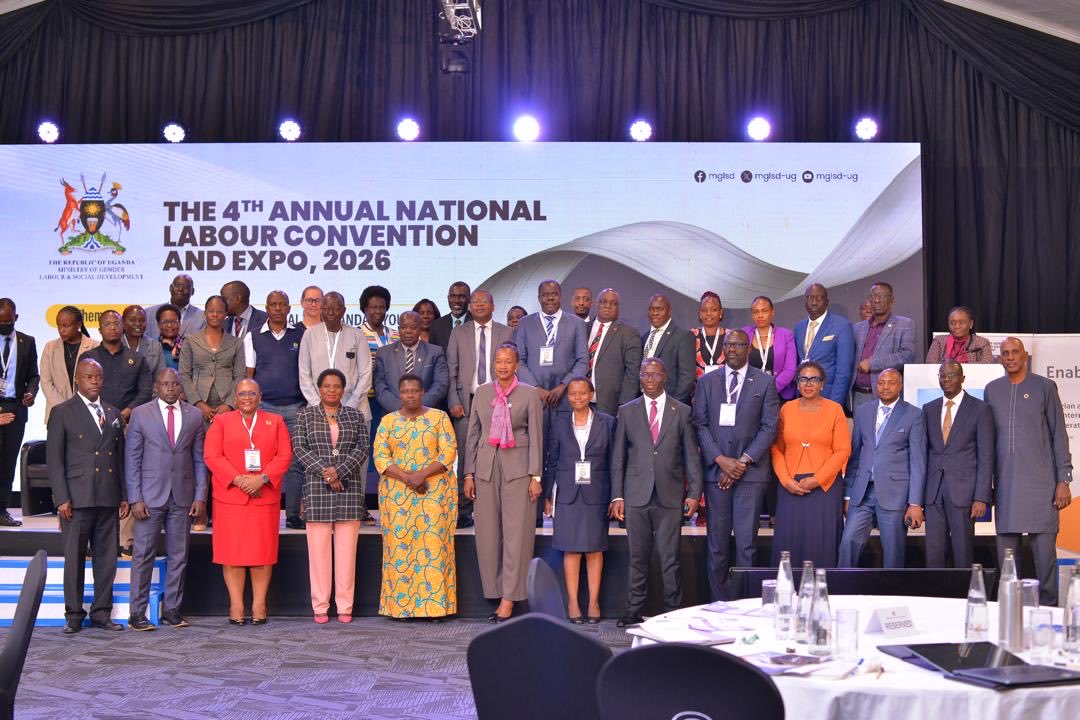
The Industrial Court of Uganda has reaffirmed its central role in advancing youth employment and safeguarding decent work during the 4th Annual National Labour Convention and Expo held at Kampala Serena Hotel.


The two-day convention, which concludes today, is running under the theme “Unlocking the Potential of Uganda’s Youth Labour Force.” It has drawn key stakeholders from government, the judiciary, private sector, and civil society to explore strategies for transforming Uganda’s youthful population into a productive and empowered workforce.
The event was officially opened by Vice President H.E Maj. (Rtd) Jessica Alupo on behalf of the President. Among the notable attendees were Lady Justice Linda Lillian Tumusiime Mugisha, Head of the Industrial Court, and Justice Anthony Wabwire Musana.
Presenting at the convention, the Acting Registrar of the Industrial Court, HW Dr. Daniel Lubowa, underscored the Court’s role as a critical institutional anchor in ensuring that employment opportunities are protected under the rule of law. He emphasized that while the convention focused on productivity and opportunity, sustainable youth employment must be grounded in strong legal protections.
Dr. Lubowa noted that decent work extends beyond job creation to include secure and fair employer-employee relationships. He explained that the Industrial Court plays a vital role in resolving disputes such as unfair dismissal, breach of contract, and workplace safety concerns, thereby promoting dignity and fairness in the labour market.
He further highlighted that national productivity thrives in an environment of industrial peace, which the Court helps maintain through timely and specialized dispute resolution. An efficient and predictable legal system, he said, reduces workplace disruptions and encourages young people to invest in long-term careers and innovation.
Discussions at the convention also focused on bridging skills gaps, aligning Technical and Vocational Education and Training (TVET) with labour market demands, supporting small and medium enterprises, and formalising youth employment. Stakeholders emphasized the need to transition young people from survival jobs into structured career pathways to drive sustainable economic growth.
Addressing the evolving nature of work, Dr. Lubowa observed that many young Ugandans are increasingly engaged in non-traditional employment such as gig work, digital platforms, and short-term consultancies. He noted that the Industrial Court is adapting by interpreting labour laws in ways that remain relevant to these emerging work arrangements.
The convention further highlighted the importance of strong institutions, positioning the Industrial Court as the enforcement backbone of the labour sector. Participants noted that without trust in fair and timely dispute resolution, many young workers may remain in informal or precarious employment.
Among the key priorities outlined by the Court are strengthening judicial oversight to guarantee decent work, expanding access through youth-focused legal aid and simplified filing processes, and maintaining a balance between protecting workers and supporting business growth.
Looking ahead, the Industrial Court announced several commitments for 2026, including the introduction of a fast-track docket for cases involving young workers aged 18 to 30, development of simplified legal guides for emerging forms of work such as gig and internship arrangements, and quarterly engagements bringing together employers, youth, and the Court.
With youth forming a significant proportion of Uganda’s population, Dr. Lubowa noted that labour disputes involving young workers are expected to dominate the Court’s caseload in the coming years. He added that the convention signals a shift in approach, positioning the Industrial Court not only as a dispute resolution body but also as a proactive partner in shaping a fair, inclusive, and future-ready labour market.