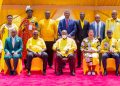





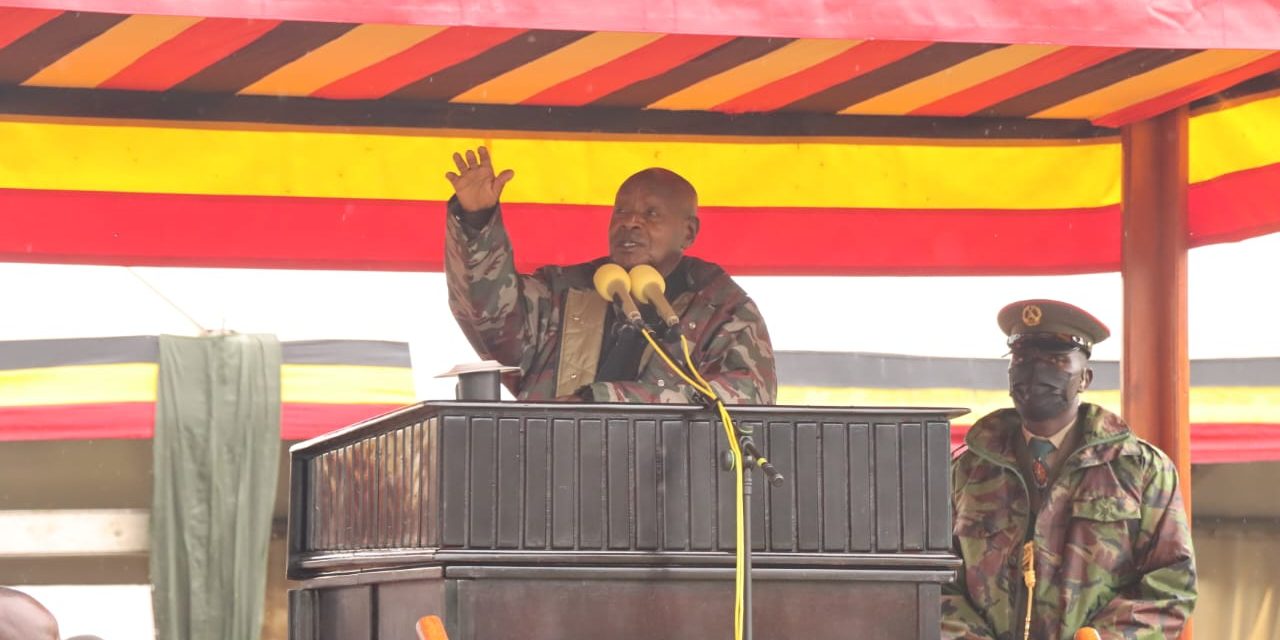
Kabale- President Yoweri Kaguta Museveni has called on Ugandans to view the history of Tarehe Sita as part of a longer and interconnected resistance struggle that laid the foundation for the 1981–1986 liberation war.

Speaking during the 45th Tarehe Sita anniversary celebrations held at Kabale Stadium, the President said Uganda’s liberation cannot be understood in isolation from earlier resistance efforts that preceded the armed struggle launched on February 6, 1981.
“As some people have said, if you only talk about Tarehe Sita, you will not do justice to the history of Uganda. There were earlier struggles which actually fed into Tarehe Sita,” President Museveni said.
Earlier in the day, the President unveiled a monument at Kabale Stadium in honour of three Ugandans—Mzee Joseph Bitwari, James Karambuzi and David Kagoro Kangire—who were executed by the Idi Amin regime on February 10, 1973. He described their deaths as part of the early resistance against dictatorship.
President Museveni noted that similar executions took place in Mbarara, Fort Portal, Jinja, Gulu and Kasese, involving individuals linked to resistance movements that later culminated in the 1981–1986 liberation struggle.
“The people who participated in Tarehe Sita had been trained earlier, and that training was built step by step, from Mozambique to Tanzania and eventually Uganda,” he said, adding that Uganda’s liberation history must be told as one connected story.
The President congratulated Ugandans for their sacrifices that laid the foundation for the country’s stability and thanked citizens for participating peacefully in the recent general elections. He also expressed appreciation to the people of Kigezi for their overwhelming support of the National Resistance Movement (NRM).
“We are celebrating Tarehe Sita, but we are also celebrating the victory we had recently in the elections,” Museveni said.
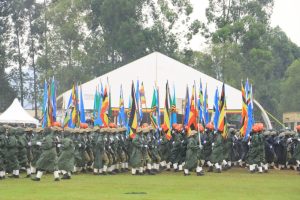
He commended the Uganda Peoples’ Defence Forces (UPDF) and other security agencies for maintaining peace during the electoral period, noting that attempts to cause instability were effectively neutralised.
On the economy, President Museveni said Uganda was registering rapid growth, having attained lower-middle-income status, with plans to reach upper-middle-income status in the coming years. He identified tourism, commercial agriculture and manufacturing as key drivers of growth, with particular focus on the Kigezi sub-region.
The President announced plans to improve tourism infrastructure, including upgrading Kisoro Airport and constructing a new international airport to improve access to Mgahinga and Bwindi National Parks. He also revealed plans to expand Mbarara Airport to boost regional trade.
On agriculture, Museveni urged farmers to adopt irrigation and fertiliser use, noting that reliance on traditional practices continued to limit productivity. He said commercial agriculture, supported by agro-processing, would raise household incomes and accelerate industrialisation.
In his remarks, the Minister of Defence and Veteran Affairs, Hon. Jacob Markson Oboth, congratulated the President on his landslide election victory and thanked him for attending the celebrations.
The Chief of Defence Forces and Senior Presidential Advisor on Special Operations, Gen. Muhoozi Kainerugaba, described the 2026 general elections as the most peaceful since 1996.
“Save for a few isolated cases, security was maintained across the country, allowing voters to carry out their civic duty in a calm and secure environment,” Gen. Muhoozi said.
He reaffirmed the UPDF’s loyalty to the President and pledged continued support towards Uganda’s socio-economic transformation and regional security, citing ongoing operations in Karamoja and peace support missions abroad. He added that improved security had boosted investment and tourism.
On welfare, Gen. Muhoozi thanked President Museveni for his guidance, which he said had contributed to improved living and working conditions for UPDF personnel.
“The feeding, clothing and accommodation of our officers and militants have continued to improve tremendously,” he said, attributing the progress to close supervision of projects and strict enforcement of value-for-money principles.
He also commended institutions under the Ministry of Defence and Veteran Affairs, including the National Enterprise Corporation, Operation Wealth Creation, the UPDF Engineering Brigade and UPDF Welfare and Production departments, for supporting soldier welfare and national production.
During the ceremony, outstanding UPDF junior officers were recognised with the inaugural Chief of Defence Forces Award for Outstanding Junior Officer. Lt. Moses Odongo of the Ground-Based Air Defence Regiment emerged winner, alongside Major Anthony Mwangi, Captain Andrew Asio Opus and Lt. Shem Begiraje.