













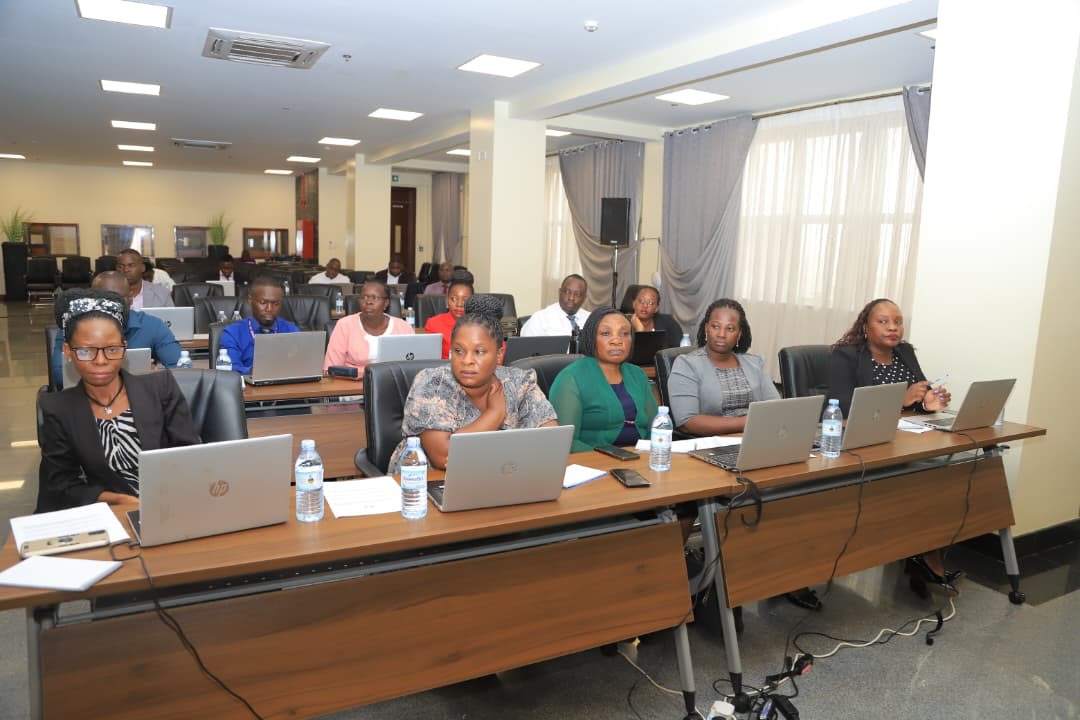
Kampala– The Electronic Court Case Management Information System (ECCMIS) Technical Committee conducted a two-day training session for non-judicial officers from Cluster Seven and Cluster One courts at the Supreme Court Conference Hall in Kampala.


The training is designed to equip participants from Cluster Seven, where ECCMIS is soon to be deployed, with practical skills on how to use the system, while also providing a refresher for staff from Cluster One, where the system was first deployed.
Participants included staff from the Supreme Court, Court of Appeal, Kiboga High Court, Kiboga Chief Magistrate’s Court, Busunju Magistrate’s Court, and Kyankwanzi Magistrate’s Court.
According to the schedule, the ECCMIS Technical Team will, over the course of two weeks (beginning Monday this week through next week), train various groups including judicial officers, support staff, and external system users such as advocates from Cluster Seven.
Introducing the system, Mr. Joseph Ssinabulya, Principal Information Management Officer and ECCMIS Project Manager, noted that the training comprises both theoretical and practical components. He added that the programme includes induction for new Systems Administrators to ensure they are adequately equipped to assist court users at their respective duty stations.
Mr. Ssinabulya emphasized the need for all cases to be fully updated in the Court Case Administration System (CCAS) before migration, explaining that ECCMIS imports only existing CCAS records and does not allow backdating.
He further revealed that ECCMIS kiosk stations will be installed at courts where the system is being rolled out to support court users who may not have access to computers or internet connectivity, at no cost.
Highlighting the system’s performance-enhancing features, Mr. Ssinabulya said ECCMIS enables performance monitoring by tracking actions and time spent on files, prevents record loss or unauthorized removal, and ensures transparent correction of errors.
He underscored the flexibility of the platform, explaining that it automates the entire case lifecycle and replaces CCAS with a system that allows parties to access their files remotely. Key functions include e-filing, online payments, mobile phone access, SMS and email notifications, and an e-seal.
He added that full adoption of ECCMIS across the Judiciary will strengthen efficiency, accountability, planning, and resource allocation.
Mr. Eddy Nsereko, Systems Administrator, guided participants through a practical session on how to use the system, including user registration and e-filing, while while Ms. Georgina Musanase (ECCMIS Systems Administrator) moderated the training