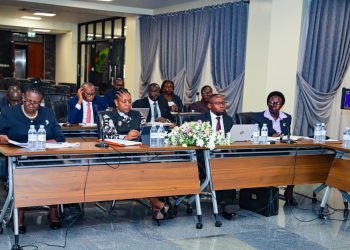





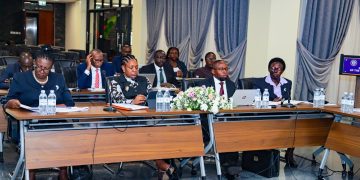
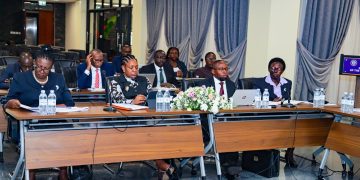






Kampala-Uganda Pentecostal University (UPU) on Saturday evening held its Grotius Annual Lawyers’ Dinner for fourth-year law students at Hotel Africana in Kampala, bringing together students, members of the Judiciary, the Uganda Law Society, and academia.


The dinner was held under the theme, “Lawyers as Healers: The Obligation of the Profession to Serve as Healers of Human Conflicts” (CJ Warren E. Burger, 1982).
Delivering the keynote address, the Acting Chief Registrar, HW Lamunu Pamella Ocaya, described the occasion as both a celebration and a moment of reflection for future lawyers.
It is an honour to be here with you today,” she said, noting that addressing a room full of aspiring legal professionals was no small task.
“It is much easier to cross-examine a witness than to decide what to say to a room full of brilliant future colleagues,” she added.
HW Lamunu shared her personal journey as a mother and wife who grew up in Gulu City in Northern Uganda, a region once affected by conflict, and rose from a humble background to serve as a member of Top Management in the Judiciary.
She said the evening marked more than academic achievement, describing it as a transition into a higher calling.
“You are stepping into a role as custodians of justice,” she said, urging the students to reflect not only on what lawyers do, but on who they ought to be.
Expounding on the theme, HW Lamunu noted that while the legal profession is often seen as adversarial, true lawyering goes beyond winning and losing cases.
“Beneath every case file is something deeply human, conflict, pain, fear, and sometimes injustice. That is where the deeper calling of the lawyer begins,” she said.
Throughout her address, she emphasized humanity and humility as central values of the legal profession, noting that lawyers must
always see the human being behind every file.
Highlighting Alternative Dispute Resolution (ADR), she described mediation as a long-standing and important avenue for resolving disputes, allowing parties to be heard and to reach meaningful, lasting resolutions.
“If you are engaged in mediation, you are playing the role of a healer,” she said. “It is not just about resolving a dispute, but about restoring relationships, dignity, and trust.”
She added that as students enter the profession, they will be entrusted with people at their most vulnerable moments.
“Your role will not only be to argue, but to listen; not only to advocate, but to understand; not only to win,
But to do what is right,” she said.
HW Lamunu also encouraged the students to reflect on their journey and celebrate their achievement, noting that their presence at the dinner was evidence of years of discipline, sacrifice, and resilience.
She cautioned them against prioritizing profit over principle and urged them to uphold the moral authority of the legal profession.
“Healing requires humanity, humility, courage, and hope,” she said.
The Chief Guest, the Principal Judge, Lady Justice Jane Frances Abodo, commended the University for organizing an event that bridges legal education and practice, noting that the theme was timely and globally relevant.
The theme is on point. It reflects the conversation we are having today not only in Uganda, but globally,” she said. “I want to thank my sister, the Acting Chief Registrar, that was a powerful keynote address.”
Lady Justice Abodo said the dinner was more than a social event, describing it as a platform for meaningful engagement.
“This is not only a dinner; it is a space where you can pick each other’s minds, exchange ideas, and build professional networks,” she said.
She reminded the students that the study and practice of law are demanding but rewarding, placing lawyers at the centre of justice delivery in society.
“Law is a demanding profession,” she said. “It is also double-edged—it can be used to heal, or it can be used to harm.”
She urged the students to remain conscious of the power they carry as legal professionals