












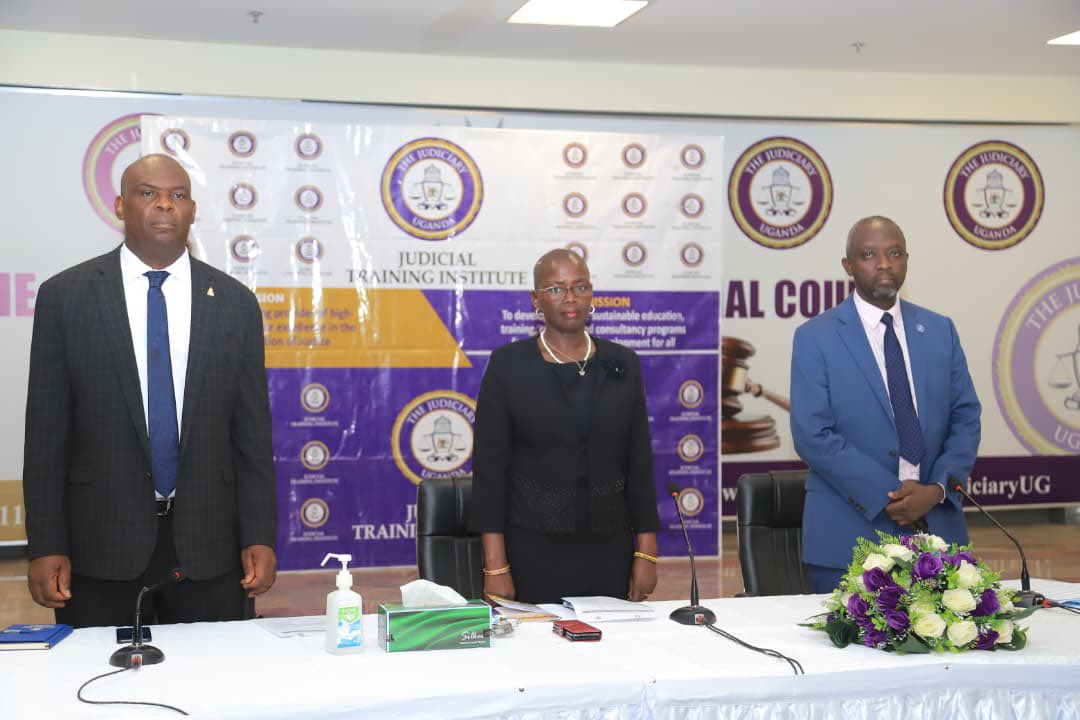
Kampala– The Principal Judge, Lady Justice Jane Frances Abodo, today officially opened a one-day intensive training programme on advanced legal research for Magistrates Grade One (Research) at the Court of Appeal Conference Hall, reaffirming the Judiciary’s commitment to strengthening research capacity as a cornerstone of quality adjudication.

In her opening remarks, Justice Abodo welcomed participants and commended the Judicial Training Institute (JTI) for conceptualizing and organizing what she described as a timely and strategic intervention. She particularly appreciated the Chairperson of the JTI Governing Council, Justice Mike Chibita, and the Executive Director, Justice Prof Andrew Khaukha, together with their team, for responding swiftly to the Judiciary’s call to enhance the competence of research magistrates.
The Principal Judge noted that the training stems from sustained internal consultations highlighting the urgent need to continuously build the analytical and research capacity of judicial officers, especially those who provide technical and advisory support to Justices and Judges. She emphasized that Magistrates Grade One Research occupy a unique and strategic position within the judicial structure, serving as the research backbone of the courts through rigorous analysis of statutes, precedents, and emerging jurisprudence, as well as the preparation of bench memoranda, draft opinions, and legal briefs that guide sound judicial decision-making.
“A well-researched brief is often the difference between an average decision and an excellent one. Your work may not always be visible in the courtroom, but it is foundational to every sound judgment we deliver,” she said.
Referencing the Judiciary’s workload, Lady Justice Abodo cited statistics shared by the Acting Chief Registrar, HW Lamunu Pamella Ocaya, indicating that 167,353 cases remain pending across all court levels. With each judicial officer managing a significant caseload, she observed that the quality, accuracy, and timeliness of research support are indispensable to efficient case disposal and the maintenance of public confidence in the justice
system.
She further described research magistrates as guardians of accuracy, custodians of methodological discipline, and contributors to the institutional memory of the Judiciary. The Principal Judge urged them to uphold three core professional standards: adopting a structured research method, strictly verifying legal authorities, and exercising a strong sense of responsibility, particularly in election-related disputes where decisions directly affect rights, political representation, and national stability.
Highlighting the evolving legal environment, the Principal Judge encouraged the participants to embrace modern tools such as embrace modern tools such as digital research engines, electronic databases, artificial intelligence platforms, and media-neutral citations, while maintaining professional judgment and ethical safeguards.
The Chairperson Governing Council Justice Mike Chibita noted that the training reflects the Judiciary’s deliberate strategy to align professional development with emerging operational demands, especially in preparation for election petitions that are legally technical, time-sensitive, and highly emotive. He added that the Institute has transitioned to a structured annual training calendar to ensure predictability, coherence, and measurable impact.