










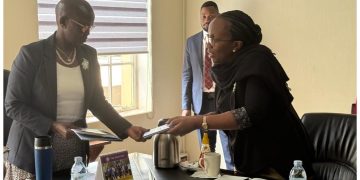




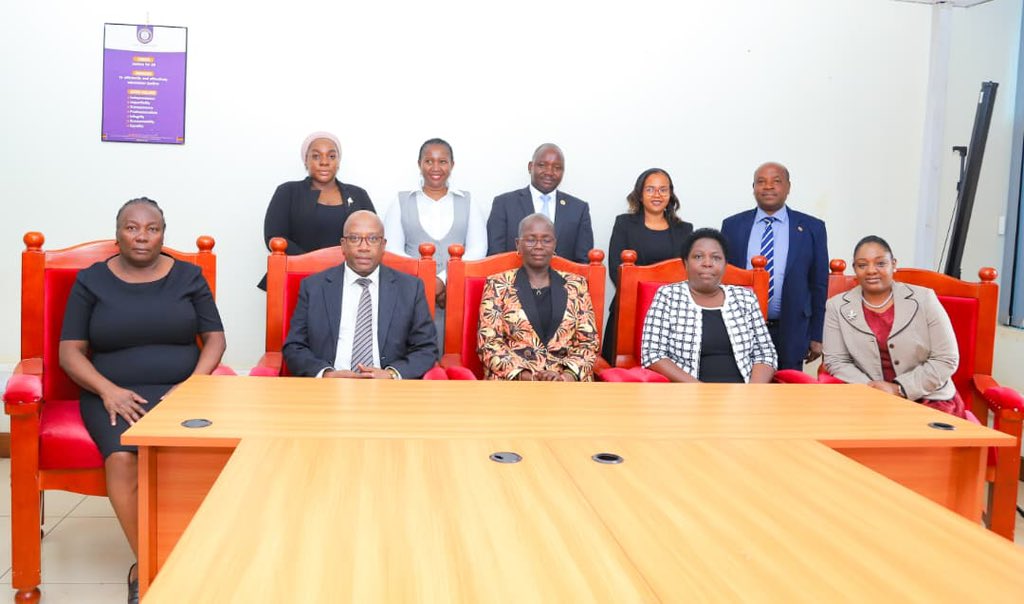
Kampala-The Principal Judge, Lady Justice Jane Frances Abodo, on Friday paid a courtesy call to the Family Division of the High Court, where she met Judicial Officers and toured the court premises to assess the Division’s performance, innovations, and operational challenges.

The visit focused on Alternative Dispute Resolution (ADR), case management, staff welfare, and infrastructure, as part of the Judiciary’s broader efforts to strengthen service delivery and improve access to justice.
On arrival, Justice Abodo was received by the Head of the Family Division, Justice John Eudes Keitirima, the Deputy Head of Division, Lady Justice Immaculate Busingye, and the Deputy Registrar
In charge of the Division, HW Samuel Olumo.
Addressing Judicial Officers, the Principal Judge commended the performance of the Family Division and called for sustained and increased institutional support to enable it to maintain its standards of excellence. She particularly commended the Division’s leadership in mediation and other ADR mechanisms, noting that it continues to set the benchmark for effective dispute resolution.
Justice Abodo encouraged the Division to further promote mandatory mediation, applauding the presence of on-site mediators despite persistent space constraints. She emphasized that ADR resources should be prioritised for Divisions and Circuits that demonstrate tangible results rather than distributed uniformly.
“The most effective Divisions are not necessarily the busiest, but those that are innovative, proactive and willing to seek support,” she observed.
She also underscored the importance of classifying cases at filing into simple, moderate and complex categories, explaining that this improves time management, enhances case flow and prevents unnecessary congestion within the justice system.
The Principal Judge commended the Division’s child-centred innovations, noting that they significantly reduce anxiety for children who interact with the courts. She further acknowledged the Division’s effective use of technology to support service delivery.
Highlighting the emotional intensity of family matters such as divorce, custody and succession, Justice Abodo stressed the importance of staff wellness and psychosocial support. She observed that judicial officers often work in isolation and may not easily share the emotional pressures associated with their work, calling for spaces that promote interaction, decompression and peer support.
She encouraged officers to openly communicate their training and support needs and urged the Division to take mental health seriously. As part of promoting personal wellbeing, she scheduled a gym session with the Family Division for Thursday, 22 January, reminding officers that health is an individual responsibility.
Justice Abodo hailed the strong collegiality within the Division and commended the leadership for fostering teamwork and accountability. She assured the Division of her full support within her mandate and added that the Registrar High Court had also committed to providing necessary operational support.
She further proposed that the next National Court Open Day should place greater emphasis on family justice, highlighting mediation and alternative dispute resolution as viable options to lengthy litigation. She stressed that mediation initiatives should be driven internally by the Judiciary.
The Principal Judge also concerns about the creation of some court circuits without adequate consultation of key stakeholders such as the Office of the Director of Public Prosecutions, Police and Prisons, noting that this has contributed to operational challenges.
Presenting the Division’s performance report, Justice Keitirima revealed that the Family Division handled 7,759 cases last year, of which 1,095 constituted general backlog. He noted that 221 cases fall under critical backlog, having been pending for more than five years, and that a detailed backlog report has already been submitted.