





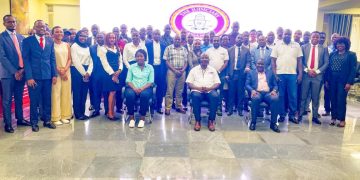
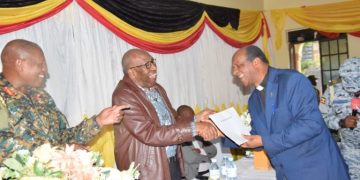



Kabale/Rukungiri– As part of the ongoing 45th Tarehe Sita Anniversary commemorations, the Uganda Peoples’ Defence Forces (UPDF) conducted a series of ideological training symposia targeting Veterans, religious leaders, and youth leaders across the Kigezi sub-region, drawing participation from hundreds of attendees and culminating in resolutions for greater community involvement and support.

The events were coordinated by the Joint Staff Political Commissariat, led by Major General Henry Masiko, on behalf of the Defence Organising Committee for Tarehe Sita Activities.
According to Maj Gen Masiko, the targeted ideological training is a recurring mobilisation activity designed to empower specific community leaders. “This year for Kigezi, we split our target groups into three,” he explained.
Over 400 youth leaders from the sub-region underwent a seven-day training at St. Gerard’s Secondary School in Rukungiri District. Separately, at Brimstone High School in Kabale, two concurrent seminars were held: one for religious leaders and another for Veterans.
In an address to religious leaders at Brianstone High School in Kabale District, the Special Presidential Envoy and former Prime Minister, Rt. Hon. Dr. Ruhakana Rugunda, emphasised the critical role of unity and ideological clarity in national development. “If this solidarity and unity continue, Uganda, instead of walking, will actually be running,” he stated.
Hon. Rugunda reflected on the historical role of religious leaders in the liberation struggle, noting figures like Father Seguya, who served on the Bush War committee and provided critical support during the movement.
Dr. Rugunda outlined the enduring impact of colonialism and slavery. “The African society suffered immensely from both slavery and the colonial mission. Even today, as I speak, we are still victims of that brutalisation,” he said.
He connected this analysis to the present mission of the National Resistance Movement (NRM), stating that the party’s long-standing struggle has been to secure Africa’s rightful place globally.
Religious Leaders Propose Partnerships
The segment for religious leaders aimed to equip them as partners in national security and ideological dissemination. In their formal resolutions, the leaders called for future government-led ideological seminars to be balanced across all denominations to ensure equitable information sharing and broader national transformation.
They urged the UPDF to provide more intensive and strategic training for clergy to enhance their effectiveness. The leaders proposed formal inclusion of religious groups in government initiatives like the Uganda Peoples’ Defence Forces (UPDF) Modernisation projects, allowing them to contribute to program improvement.
Addressing community needs, they highlighted a critical shortage of organised youth facilities and requested government support to develop playgrounds and training centres.
They appealed for official recognition of religious leaders in government programming, noting that their influential community contributions are often overlooked in national development plans.
Veterans Express Gratitude, Commit to Cascading Knowledge
The Veterans’ seminar served as a routine ideological refresher and a platform for regional networking. “They were very happy that they were able to meet, compare experiences and get re-energised together,” Maj Gen Masiko noted.
A key component was educating Veterans on the enhanced benefits under the amended UPDF Act(2025). Officers from the pension department and legal team detailed improvements, including medical care, dignified burial provisions, and critical pensions now commensurate with the current salary scales of actively serving personnel of equivalent rank.
Veterans present, including Capt (Rtd) Alisene Wedgie and Capt (Rtd) Damson Christmas Chivumba, expressed profound gratitude for the recognition and sustained support from the state.
They emphasised their commitment to cascading the lessons learned including practical skills, ideological orientation, and entrepreneurial knowledge back to their districts to support fellow veterans, their families, and local communities.
Furthermore, they advocated for retired military personnel to engage in politics and community leadership as disciplined, service-oriented figures, praising the facilitators for equipping them to lead productive and respected lives post-service.